01 / HEMP-SPECIFIC LIME
Compatible render and plaster
Products expressly designed for hemp substrates can provide a documented route. Confirm which substrate, internal or external use, preparation and reinforcement the manufacturer covers.

FINISHES / SYSTEMS / CRAFT
Understand lime, cork-lime and Venetian-style finishes. Compare the documented systems, then specify for your wall, exposure and desired appearance.
Compare the systemsTHREE DIFFERENT DECISIONS
01 / HEMP-SPECIFIC LIME
Products expressly designed for hemp substrates can provide a documented route. Confirm which substrate, internal or external use, preparation and reinforcement the manufacturer covers.
02 / CORK-LIME
Selected cork-containing lime plasters have specific hemp-block instructions. A cork product’s label alone does not establish compatibility with cast hemp-lime, every block or every final coating.
03 / DECORATIVE LIME
A fine decorative finish belongs over its approved prepared base. Confirm primer, base, polish and any soap or wax together. It is not automatically an exterior or wet-room waterproofing system.
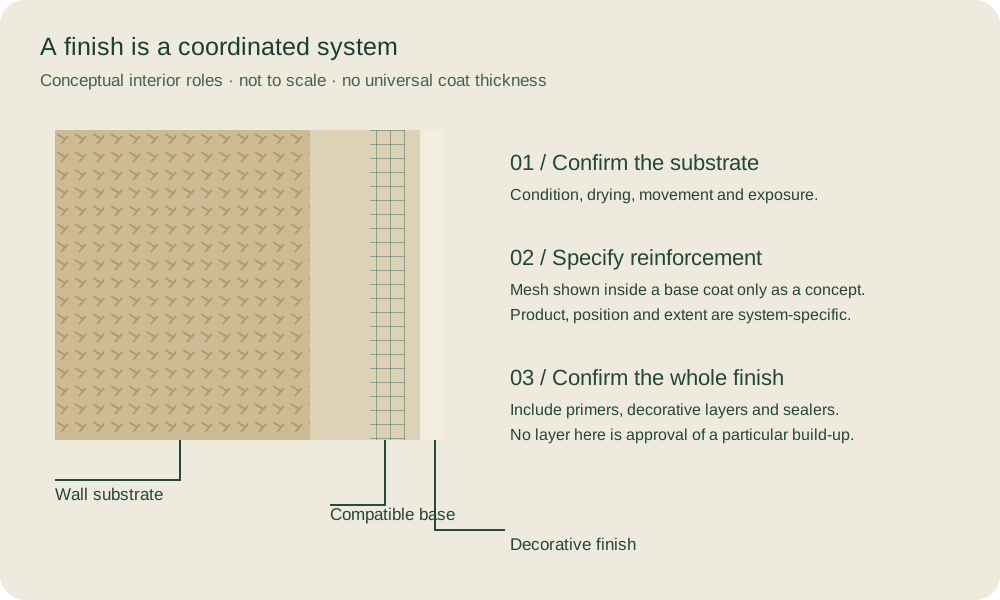
THE WHOLE BUILD-UP MATTERS
The substrate, base and finishing products work together. A compatible mineral coat cannot cancel out an unsuitable primer, trapped moisture or an unaddressed movement joint.
Use the chosen supplier’s current technical documents and a competent designer or installer. Values below belong to named products, not to hempcrete generally.
DOCUMENTED EXAMPLES / NOT A MIX-AND-MATCH SPECIFICATION
Scope: approved hemp blocks and hempcrete made with the specified Saint-Astier binders. Not every hemp wall.
Documents differ on the second-pass timing. Obtain the current agreed specification; no combined schedule is offered here.
2023 application documentScope: the technical sheet expressly covers hemp-lime/hemp-concrete blocks with Polites 140 reinforcement. This does not approve every cast-in-situ wall.
Hemp blocks require the named mesh even below the generic 60 mm reinforcement threshold stated elsewhere in the document.
Diathonite technical sheetScope: selected prepared absorbent interior plaster. No blanket direct application onto rough hempcrete; permanently humid surfaces are excluded.
Confirm preparation, primer and optional soap/wax together. Do not assume a stated property covers all finish combinations.
Stucco Fine product sheetNo supplier partnership or product recommendation for an unassessed wall is implied. Never combine one maker’s mesh with another maker’s coat system without documented approval.
SAND, GRAIN AND SURFACE
Granulometry describes the manufacturer’s supplied aggregate or grain range. It is not permission to add sand or replace the aggregate. Follow the product instructions; changing the mix can change workability and performance.
Aggregate grading, cleanliness, shape and binder choice belong in a project-specific specification. There is no universal sand grade or mix ratio suitable for every hemp substrate, exposure and finish.
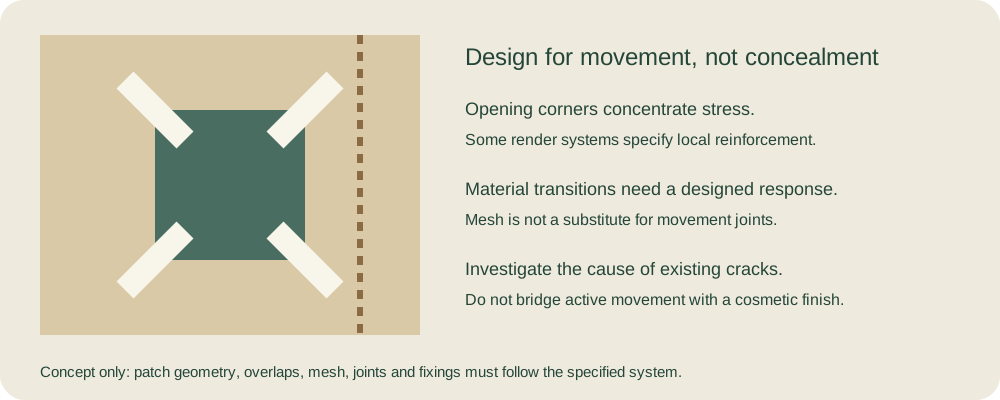
MANAGE THE CAUSE
Confirm whether mesh is required over the full surface, at transitions, around openings or in multiple locations. Use the prescribed alkali resistance, weight, aperture and embedding method.
Structural movement, incompatible materials, poor readiness and rapid drying require investigation. A decorative skim should not hide active cracking or water ingress.
VAPOUR, RAIN AND AIR
Water-vapour resistance is a material property, not a health guarantee. The complete build-up, thickness and coatings matter. A product’s μ value is a vapour-resistance factor; it is not a promise that the finished house cannot develop condensation or mould.
Some materials absorb and release vapour as humidity changes. Finish choices affect that exchange.
Rain, splashback, openings and exposed junctions need their own protection. Vapour permeability is not waterproofing.
Walls do not replace a ventilation strategy. Control moisture sources, leaks and cold surfaces as part of the whole home.
PROFESSIONAL WORKFLOW
Wall system, exposure and room use first. Exterior render and interior decorative finish do different jobs.
Check stability, condition and drying. Prepare and control suction to the chosen product instructions.
Use the compatible base and any specified transition reinforcement. Fine polish does not go straight onto unsettled coarse infill.
Protect lime work from damaging weather and rapid drying. Follow the specified coat sequence, not a generic timetable.
Check colour, texture and sheen. Confirm the primer, base, finish and any soap, wax or sealer as one system.
Inspect weather protection and address leaks. A beautiful surface cannot resolve persistent damp underneath.
Lime products can harm skin and eyes; powders require dust controls. Follow the actual safety data sheet, risk assessment and protective-equipment requirements. Do not infer readiness from a generic day count or use this guide as a DIY recipe.
KALAMUA 2025 Declaration of Performance
Bath: finishes affect moisture buffering
Manufacturer evidence checked 15 November 2026. Technical documents linked beside each example. These are separate product examples, not a composite installation method. Confirm current revisions and project suitability with the manufacturer.
FROM CURIOSITY TO A CLEARER BRIEF
Five simple questions. A useful starting point, not a technical specification.